|
Breast milk is the best food for your baby. The World Health Organization (WHO) and the Ministry of Health and Family Welfare (MoHFW), Government of India, recommend exclusive breastfeeding for the first six months, followed by nutritious home-made complementary foods while breastfeeding continues up to two years of age or beyond. |
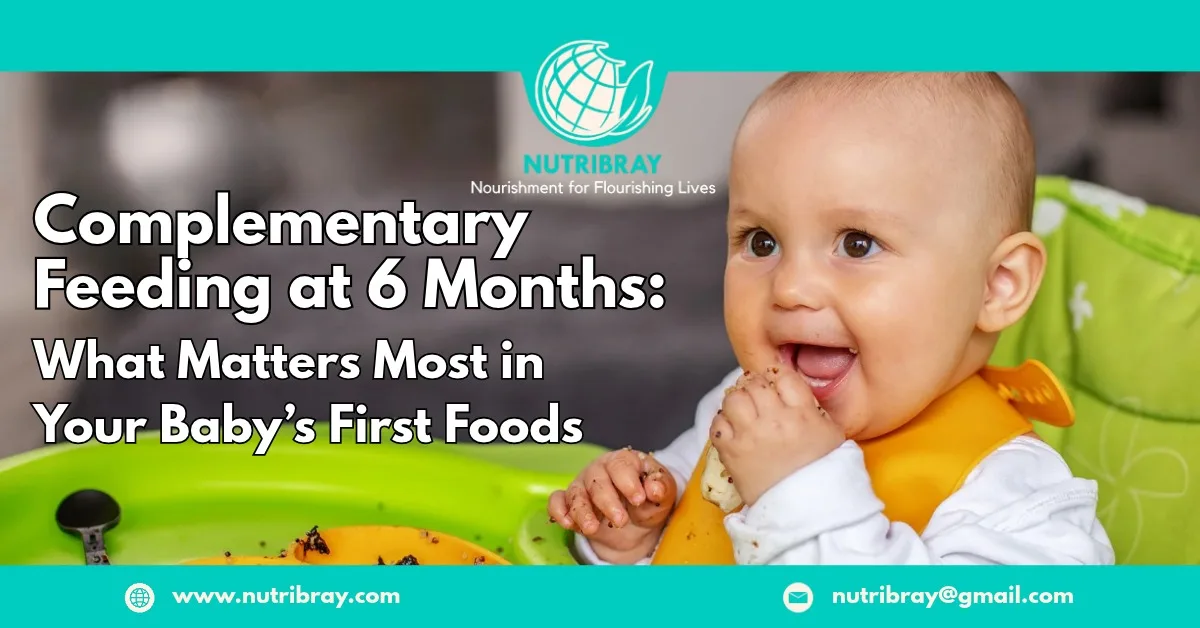
A six-month-old who has spent weeks watching every spoonful travel from your plate to your mouth will, sooner or later, reach for it. That moment marks the start of complementary feeding: the gradual introduction of family foods alongside continued breastfeeding. In many Indian homes, it is marked with annaprashan, a baby’s first-rice ceremony.
Complementary foods do two jobs at once. They fill the nutritional gaps that breast milk alone can no longer cover, and they teach a child what food tastes and feels like. In these early months, what goes on the spoon matters far more than how much of it is finished.
This guide explains when to start, which nutrients to prioritise, how much and how often to feed, how to keep food safe, and which foods to keep off the spoon in the first year.
Why six months is the right time to start complementary feeding.
WHO and MoHFW recommend that babies receive only breast milk for the first six months: no other milk, food, drink or water. From six months, complementary foods are introduced while breastfeeding continues up to two years or beyond.
This timing has a biological basis. Healthy, full-term babies are born with iron stores built up during pregnancy, and these usually last for about the first six months. Around this age, a growing baby’s needs for energy, iron, zinc and several other nutrients begin to exceed what breast milk alone can provide. Breast milk remains an excellent food, and the iron it contains is well absorbed, but from six months other foods have to make up the difference.
Babies born preterm or with a low birth weight may run short of iron sooner. Their doctor may advise iron supplements or a different feeding plan.
Signs your baby is ready for solid food
Around six months, most babies show these three signs together:
- They can stay in a sitting position and hold their head steady.
- They can coordinate their eyes, hands and mouth to pick up food and bring it to their mouth.
- They swallow food rather than pushing it back out with the tongue.
Chewing fists, waking more often at night or wanting extra feeds are common in young babies, but they are not reliable signs of readiness for solid food.
Breastfeeding still matters after six months
Starting solids does not mean stopping breastfeeds. According to WHO, breast milk can provide half or more of a child’s energy needs between 6 and 12 months of age, and around one-third between 12 and 24 months. It also continues to protect against infections such as diarrhoea and pneumonia.
- Continue to breastfeed on demand, by day and night.
- Offer complementary foods with a clean katori and spoon or an open cup rather than a feeding bottle.
- If you are worried about your milk supply, ask for support from a doctor, lactation counsellor, ANM or ASHA worker before introducing other milks or foods.
Why bottle feeds and breast milk substitutes need care
Even partial bottle feeding can reduce breastfeeding: a baby who suckles less at the breast stimulates less milk production, and once breastfeeding has been reduced or stopped, it can be difficult to re-establish. Infant milk substitutes and feeding bottles add a regular cost to the household. If they are prepared with unsafe water, in the wrong proportions or with bottles and teats that are not properly cleaned, they can cause infections such as diarrhoea and may lead to poor growth. If a baby cannot be breastfed for any reason, feeding should be planned with the advice of a doctor.
What a small stomach needs from every spoonful
A baby’s stomach holds very little, so first foods need to be nutrient-dense. Thin, watery preparations such as dal water or rice water fill the stomach quickly without delivering much energy or nutrition. This is why thick, soft preparations are preferred from the start: the food should be thick enough to stay on a spoon without running off.
Key nutrients and where to find them in an Indian kitchen
- Iron and zinc: meat, fish, poultry and egg are good sources. Pulses such as dal, millets such as ragi, and green leafy vegetables also contribute, particularly in vegetarian diets.
- Energy: a little ghee or oil stirred into khichdi, dalia or porridge raises its energy content without adding bulk.
- Vitamin A: orange and yellow fruit and vegetables such as carrot, pumpkin, papaya and ripe mango, and green leafy vegetables.
- Vitamin C: fruit and vegetables served in the same meal improve the absorption of iron from plant foods.
- Protein and calcium: dal, curd, soft paneer, egg and well-cooked meat or fish.
Aim for variety every day
WHO’s 2023 guideline on complementary feeding places the emphasis on variety. It advises that animal-source foods, fruit and vegetables be eaten daily, and that pulses, nuts and seeds be eaten frequently, especially where meat, fish and eggs are limited. It also advises choosing nutrient-rich foods over meals made mostly of starchy staples.
A simple way to check variety is to count food groups. WHO considers a child aged 6–23 months to have minimum dietary diversity when they eat foods from at least five of these eight groups in a day:
- Breast milk
- Grains, roots and tubers (rice, wheat, ragi, potato)
- Pulses, nuts and seeds (dal, besan, finely ground nuts)
- Dairy (curd, paneer, milk used in cooking)
- Flesh foods (meat, fish, poultry, liver)
- Eggs
- Vitamin A-rich fruit and vegetables (carrot, pumpkin, papaya, mango, leafy greens)
- Other fruit and vegetables (banana, apple, lauki, beans)
Variety matters in India, where the National Family Health Survey (NFHS-5, 2019–21) found that 67.1% of children aged 6–59 months were anaemic. Vegetarian families can meet most needs with dal, curd, paneer, ground nuts and seeds, and leafy vegetables; a doctor or dietitian can advise on iron if a baby eats no animal-source foods.
How much and how often: a feeding guide from 6 to 23 months
Start small and build up gradually. The amounts below, adapted from WHO, are for an average breastfed baby. Appetites vary, so let your baby’s hunger and fullness cues guide you.
|
Age |
Texture |
Meals per day |
Amount per meal |
|
6–8 months |
Thick porridge and well-mashed foods; then mashed family foods |
2–3 meals plus frequent breastfeeds; 1–2 snacks depending on appetite |
Start with 2–3 tablespoons; increase gradually to half of a 250 ml katori |
|
9–11 months |
Finely chopped or mashed foods, and soft foods the baby can pick up |
3–4 meals plus breastfeeds; 1–2 snacks |
Half of a 250 ml katori |
|
12–23 months |
Family foods, chopped or mashed if needed |
3–4 meals plus breastfeeds; 1–2 snacks |
Three-quarters to one full 250 ml katori |
Source: WHO, Child health and development – questions and answers. Babies who are not breastfed need additional meals; their feeding should be planned with a doctor.
Texture, pace and responsive feeding
Most babies begin with smooth or well-mashed food. Over the following months, mashed, lumpier and soft finger foods gradually replace purées, and by their first birthday most children can eat the same foods as the rest of the family, cut or mashed as needed. Learning to chew is a skill, and it needs practice; staying on smooth purées for too long can make the move to family food harder.
Responsive feeding means paying attention to your baby’s signals:
- Sit facing your baby, feed slowly and patiently, and talk to them during meals.
- Encourage, but never force, your baby to eat.
- Keep mealtimes free of screens and other distractions.
- Stop when your baby turns away, closes their mouth or pushes the spoon away. This protects a child’s natural ability to regulate how much they eat.
Keep it clean: food hygiene for babies
Young children are especially vulnerable to diarrhoea, so safe preparation matters as much as what is on the plate.
- Wash your hands, and your baby’s hands, with soap and water before preparing food and before feeding.
- Use clean utensils and feed with a katori and spoon or an open cup. Feeding bottles are hard to clean properly.
- Prepare food fresh and serve it soon after cooking. Do not leave cooked food at room temperature for more than two hours.
- Use safe drinking water, boiled and cooled where the water supply is not reliably safe.
Foods to avoid for babies under one year
- Salt: babies’ kidneys cannot cope with much salt. Babies under one year need less than 1 g of salt a day, which they get from breast milk and food, so do not add salt to their food. Take out your baby’s portion before adding salt and strong spices to the family pot, and avoid salty foods such as papad, pickles, namkeen and stock cubes.
- Sugar and sugary drinks: added sugar, jaggery and sweets contribute to tooth decay and encourage a preference for sweet tastes. WHO advises that sugar-sweetened drinks should not be given to children aged 6–23 months and that even 100% fruit juice should be limited. Whole, mashed fruit is a better choice.
- Honey: honey can contain bacteria that cause infant botulism, a rare but serious illness. Do not give honey, even a small taste, until after your baby’s first birthday.
- Whole nuts and other hard, round foods: these are choking hazards. Whole nuts should not be given to children under five years of age. Nuts can be given finely ground or as a smooth paste instead.
- Highly processed snacks: foods high in salt, sugar or unhealthy fats, such as chips, biscuits and fried snacks, offer little nutrition and can displace healthier foods.
Introducing common allergenic foods
For most babies, foods such as egg, peanut, wheat (gluten), fish and dairy do not need to be held back. They can be introduced from around six months, one at a time, so that any reaction is easier to spot. Give peanuts and other nuts only finely ground or as a smooth paste, and make sure eggs are well cooked. Once a food is tolerated, keep offering it as part of your baby’s usual diet.
If your baby has eczema, a known food allergy, or a family history of food allergy, eczema, asthma or hay fever, speak to your paediatrician before introducing these foods. Seek urgent medical help if your baby has difficulty breathing, a swollen face, lips, tongue or throat, or becomes suddenly pale or floppy after eating.
Feeding your baby during and after illness
Babies often eat less when they are unwell. During illness, continue breastfeeding, and breastfeed more often if possible. Offer small amounts of soft foods your baby likes. Breastfeeding should not be stopped during diarrhoea. After the illness, offer food more often than usual for a while to help your baby regain lost weight. If your baby refuses all feeds, has repeated vomiting, fewer wet nappies or other danger signs, see a doctor promptly.
Questions parents often ask
Can solid food be started before six months?
WHO and MoHFW recommend exclusive breastfeeding until six months. Giving other foods or drinks earlier, including water, can increase the risk of diarrhoea and reduce breast milk intake. If you are concerned about your baby’s growth or your milk supply, talk to your paediatrician or a lactation counsellor rather than starting solids early. Babies born preterm may be given individual advice by their doctor.
Does my baby need water once solids begin?
From six months, you can offer small sips of safe water, boiled and cooled where needed, from an open cup with meals. Breast milk remains the main drink throughout the first year.
Will solid food replace breastfeeds?
Not at first. Early meals are small, and breast milk continues to provide half or more of a baby’s energy between 6 and 12 months. The balance shifts gradually towards family food as the first birthday approaches, while breastfeeding continues up to two years or beyond.
What are good first foods for a 6-month-old Indian baby?
Simple home-cooked foods work well: well-cooked and mashed dal and rice (khichdi) with a little ghee, ragi or suji porridge, mashed banana, stewed apple, and mashed vegetables such as pumpkin, carrot or potato. Keep the texture thick and smooth to begin with, and do not add salt or sugar.
How do I know my baby is eating enough?
Regular weight and length checks are the best guide. Have your baby’s growth recorded on the growth chart in the Mother and Child Protection (MCP) card at your health centre or anganwadi, and discuss any concerns with your doctor, ANM or anganwadi worker.
Conclusion: a lifelong habit starts with one spoon
The first year of eating is less about clean bowls than about steady exposure to varied, iron-rich, home-cooked food with no added salt or sugar, offered patiently and hygienically alongside continued breastfeeding. Every family’s routine will look a little different. Your paediatrician, ANM, ASHA or anganwadi worker can help you adapt these principles to your baby’s needs.
|
Important: Breast milk is the best food for your baby. This article is for general educational purposes only and does not replace individual advice from a qualified healthcare professional. Please consult your paediatrician for guidance specific to your child. Published by Nutribray Healthcare Private Limited. Date of publication: [DD Month YYYY]. |
References
- World Health Organization. WHO Guideline for complementary feeding of infants and young children 6–23 months of age. Geneva: WHO; 2023. https://www.who.int/publications/i/item/9789240081864
- World Health Organization. Infant and young child feeding (fact sheet). https://www.who.int/news-room/fact-sheets/detail/infant-and-young-child-feeding
- World Health Organization. Child health and development (questions and answers). https://www.who.int/news-room/questions-and-answers/item/child-health-and-development
- World Health Organization. Five keys to safer food manual. https://www.who.int/publications/i/item/9789241594639
- Ministry of Health and Family Welfare, Government of India. National Guidelines on Infant and Young Child Feeding. https://main.mohfw.gov.in/sites/default/files/308320517NATIONAL%20GUIDELINES%20ON%20INFANT%20AND%20YOUNG%20CHILD%20FEEDING.pdf
- National Health Mission, MoHFW. MAA (Mothers’ Absolute Affection) Programme – Infant and Young Child Feeding Flip Chart. https://nhm.gov.in/MAA/Flip_Chart/Flip_Chart_English.pdf
- International Institute for Population Sciences and MoHFW. National Family Health Survey (NFHS-5), 2019–21: India Fact Sheet. http://rchiips.org/nfhs/NFHS-5_FCTS/India.pdf
- NHS (UK). Your baby’s first solid foods. https://www.nhs.uk/conditions/baby/weaning-and-feeding/babys-first-solid-foods/
- NHS (UK). Foods to avoid giving babies and young children. https://www.nhs.uk/conditions/baby/weaning-and-feeding/foods-to-avoid-giving-babies-and-young-children/
- NHS (UK). Food allergies in babies and young children. https://www.nhs.uk/conditions/baby/weaning-and-feeding/food-allergies-in-babies-and-young-children/